
Small Spaces, Smarter Living.


Every home has a few rooms that work hard but never get the credit — or the design attention. The laundry room. The kitchen with that inexplicable gap above the cabinets. The closet you’ve been pretending doesn’t exist. Fixing small spaces for smarter living doesn’t require a renovation. It requires a shift in thinking.
Part One: The Laundry Room Transformation Nobody Saw Coming

The laundry room is the hardest-working room in your home, and somehow it is almost always the last to get any design attention. Most people accept the default — two machines side by side, a wire shelf overhead, bare walls. It functions. It doesn’t inspire.
That changes the moment you start thinking vertically.
Look at the after. The washer and dryer are stacked — instantly reclaiming an entire wall. White shaker cabinets run all the way to the ceiling. A marble-topped corner vanity with a brushed gold faucet turns a purely utilitarian space into something that looks considered and intentional. Under-cabinet lighting. Gold hardware throughout.

The result looks custom because it was designed — not defaulted into. And the storage gain is real. Every inch of that wall is now functional.
Vertical space is the most underused real estate in your home. Once you start thinking up, everything changes.
01 — Stack the Machines. Stacking your washer and dryer doesn’t reduce capacity — modern stackable units are just as powerful. What you gain is an entire wall back to design with.
02 — Go to the Ceiling. Extend cabinets all the way up. Top shelves hold seasonal or overflow items. Everyday supplies stay at eye level. Zero wasted space.
03 — Add a Utility Sink. A corner sink earns its footprint every day — hand-washing delicates, pre-treating stains, filling the steam iron. Small addition, big return.
04 — Hardware as Finish. Brushed gold pulls and a matching faucet are the difference between “functional” and “finished.” Never underestimate what hardware does for a room.
Part Two: The Kitchen Cabinet Gap That Has to Go
Walk into almost any kitchen and look up. There it is — that 12-to-24-inch gap between the top of the cabinets and the ceiling. Sitting there collecting dust, dead air, and the occasional forgotten holiday serving dish since the kitchen was first installed.
It is one of the easiest problems to fix, and one of the most visually impactful.
Extending your cabinets all the way to the ceiling accomplishes two things at once: it adds meaningful storage, and it creates the visual impression of a taller, more expansive room. The uninterrupted vertical line draws the eye upward and makes the space feel custom — even in a modest galley kitchen.

In this narrow galley renovation, shaker-style cabinets run floor-to-ceiling on both walls. The continuity is clean and intentional. Under-cabinet LED strips add warmth and depth. Rich hardwood floors anchor the whole composition. It is a kitchen that looks designed, not assembled.
Why the Gap Needs to Go:
— The ledge above standard cabinets is functionally impossible to clean and visually impossible to style convincingly
— Floor-to-ceiling cabinets add meaningful storage for platters, seasonal pieces, and bulk pantry items
— The unbroken vertical line creates the illusion of a higher ceiling — especially important in compact spaces
— It signals a custom, considered kitchen without expanding a single wall
— Glass-front upper sections on the top doors keep the look open and airy rather than heavy
Part Three: The Closet System That Changes Your Morning

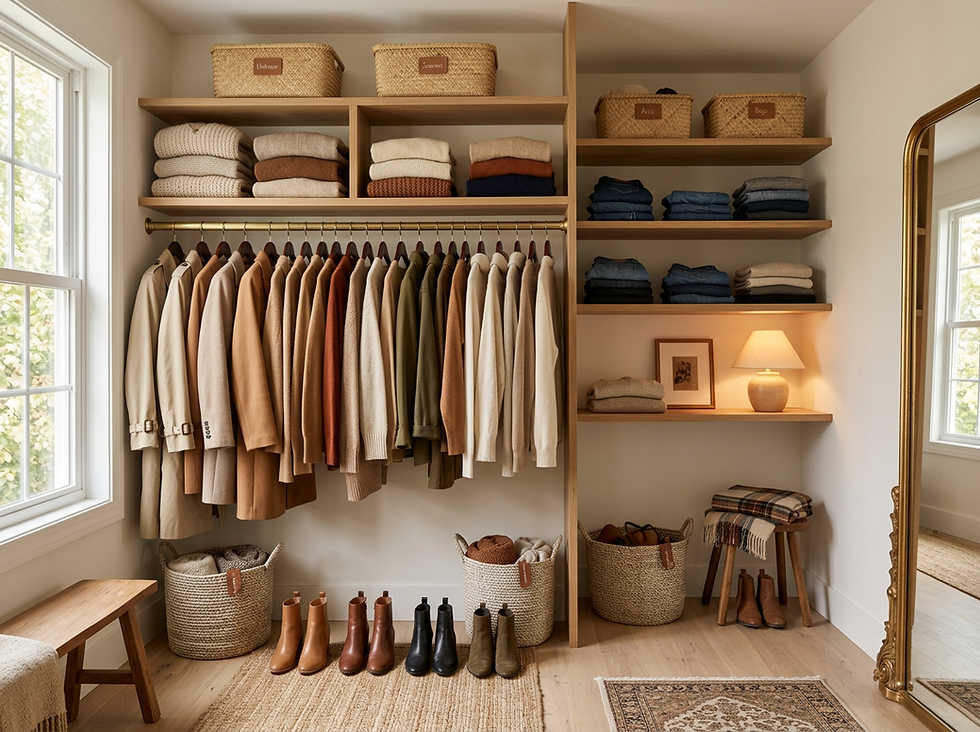
Your closet is either a daily source of calm or a daily source of friction. Very little middle ground exists. The fix starts the same way as the laundry room and the kitchen: stop stopping at eye level.
Shelves and rods that end halfway up the wall are leaving your most valuable real estate untouched. Extend everything to the ceiling. Double hang where garment lengths allow. Stack shelves for folded items and shoes. Reserve the highest shelves for seasonal pieces — luggage, formal wear, things you access a few times a year. Keep what you wear daily at comfortable reach.
Once the structure is right, the organizing system is what sustains it. And right now, the most useful framework I’ve come across comes from Nate Berkus.
Currently Reading: Nate Berkus — Foundations

Buy Your Copy Here
Berkus’s closet method is deceptively simple and genuinely effective. Three rules, applied in layers: Sort by Color. Sort by Size. Sort by Usage. Follow all three and your closet practically maintains itself. The book is full of this kind of thinking — practical, design-forward, and grounded in how people actually live.
The Nate Berkus Method:
— Sort by Color — Arrange clothing in a gradient from light to dark, or by color family. The visual harmony is immediate, and you’ll finally see what you actually own.
— Sort by Size — Within each color group, move from shorter garments to longer. Long coats and dresses at one end, cropped pieces at the other.
— Sort by Usage — What you reach for every day lives front and center at eye level. Occasion pieces move to higher shelves or further back. Eliminate friction from your morning entirely.
The combination is what makes it work. Color-sorting alone looks beautiful. Size-sorting alone is logical. All three layered together create a system — one that holds itself accountable over time.
The Takeaway:
Think Up. Edit Down. Live Better.
The thread connecting all three of these transformations is identical: vertical space is your most underused asset. Stack your laundry machines. Close the gap above your kitchen cabinets. Build your closet all the way to the ceiling. The most impactful design decisions in a home often happen right above eye level — and most people never look up.
These are not major renovations. They don’t require moving walls or relocating plumbing. They require intention — deciding that every inch of your home deserves to be considered, designed, and used well.
Start with one space. Go to the ceiling. See what shifts.

Comments